
The Second Life Of Recorded Sounds (2020)
The Soundscape Research Studio at the Institute of Cultural Studies and the Institute of Musicology at the University of Wrocław organized the international scientific online conference. This event was the third edition of the CENSE annual conference, following conferences in Budapest (2018) and Ústí nad Labem (2019). The conference took place as an online event, 22 – 24 October 2020.
Programme: Thursday October 22
10.00–10.15 OPENING
Session 1
Chair: Dariusz Brzostek (Nicolaus Copernicus University, Toruń)
10.15–10.45 Anna Maria Busse Berger (University of California, Davis)
The Search of Medieval Music in Africa and Germany, 1891-1961: Scholars, Singers, Missionaries
10.45–11.15 Piotr Cichocki (University of Warsaw)
Field Recording Beyond the Fieldwork. A Pure Documentation or a Cooperative Experiment
11.15–11.45 Anna Markowska (University of Wrocław)
Sound Archives and the (Re)Construction of Cultural Identity
11.45–12.15 COFFEE BREAK (DIY)
Session 2
Chair: Anna Kvicalova (Charles University, Prague)
12.15–12.45 Uta Schmidt, Richard Ortmann (University of Duisburg-Essen)
The Second Life of the Recorded Creaking and Moaning of a Silesian Mine Cars Circulation
12.45–13.15 Michał Witek (University of Wrocław)
The Soundscapes of the Necrocene – the Role of Sounds and Sound Archives in the Natural History Exhibitions
13.15–13.45 Jadwiga Zimpel (Adam Mickiewicz University, Poznań)
Use of Urban Sound Archives In Grassroots Evaluation of Urban Restructuring
Friday October 23
Session 1
Chair: Piotr Cichocki (University of Warsaw)
10.00–10.30 Jacek Smolicki (Linköping University)
From the Impulse to Enliven the Archive to the Composition of New Modalities of Archiving
10.30–11.00 Anna Kvicalova (Charles University, Prague)
(In)Visible Sounds: Voice Dissection in the Czechoslovak Fonoscopy Lab
11.00–11.30 COFFEE BREAK (DIY)
Session 2
Chair: Csaba Hajnoczy (Moholy-Nagy University of Art and Design, Budapest)
11.30–12.00 Paweł Szroniak (Contemporary Museum Wrocław)
Extended Listening and It’s Choregraphies
12.00–12.20 Beata Anna Targosz (Berlin)
Hybrid environments ‒ Speculative Soundscapes
12.20–12.50 Michal Kindernay (Prague)
The Memory of Sound Images
12.50–13.20 Pedro Oliveira (Helsinki Collegium for Advanced Studies, 2021)
offensichtlich unbegründet (work-in-progress) [Q&A live to the pre-recorded lecture-performance]
Saturday October 24
Session 1
Chair: Magdalena Zdrodowska (Jagiellonian University, Cracow)
10.00–10.30 Sara Pinheiro (CAS/FAMU Prague; University of Bangor)
Field Recording: Politics of Sonic Data
10.30–10.55 Renata Tańczuk (University of Wrocław)
Studium and Punctum in Recordings of the Urban Soundscape
10.55–11.20 Sławomir Wieczorek (University of Wrocław)
On Mishearing Recordings. The Case of Ryszard Siwiec’s Tape from 1968
11.20–11.50 Antoni Michnik (The Institute of Art of the Polish Academy of Sciences, Warsaw)
What Do Recordings Want? What Do Voices Want? The Second Life of Recordings From First World War German POW Camps
11.50-12.10 COFFEE BREAK (DIY)
Session 2
Chair: Jan Krtička (Jan Evangelista Purkyně University, Ústí nad Labem)
12.10–12.40 Csaba Hajnoczy (Moholy-Nagy University of Art and Design, Budapest)
Soundscape Composition vs Field Recording Based Composition in the Hungarian Contemporary Praxis
12.40–13.10 Julius Fujak (Constantine the Philosopher University, Nitra)
Milan Adamčiak. “Joy In Sound!” (Music-Intermedia Suchness of His Graphic Scores and Performances)
13.10–13.40 Daniel Brożek (sound art curator, Wrocław)
Sound as a Function of Time, Space and Memory – Art Aided Listening in Examples
13.40–14.10 OR poiesis (alias Petra Kapš) (Maribor)
KAMIsTONE [Q&A live to the pre-recorded listening session and presentation]
14.10–14.30 Gerard Lebik (Sanatorium of Sound, Sokołowsko)
Sanatorium of Sound Festival, Presentation of the Festival [Q&A live to the pre-recorded lecture]
The idea behind the conference
The history of sound recording and the recording process itself are key concerns for the field of sound studies. In recent years, researchers have discovered increasingly older forms of sound recording and inscription (e.g. research conducted by the First Sounds Group on Scott de Martinville’s phonautograph resulted in moving the date of the beginning of sound recording back to the 1860s.) Meanwhile, the notion of a “second life” of recorded sounds represents an important area for further inquiry. This notion refers to the problem of re-using archival, non-musical recordings in scientific research, as well as in the context of artistic, educational, environmental and political activities. Various types of sound archives offer important resources for historical, cultural, media, anthropological, musicological or sociological studies, as well as valuable material for artists. It is worthwhile to research within not only institutional contexts, but also private sound archives and collections, whether recently established or those with a long tradition. Today, the common practice of recording the sounds of everyday life using smartphones and portable recorders also raises questions about the future fate of these vast repositories of recordings.
We would like to reflect on the techniques and methods of re-using and re-mediating archival recordings of urban sounds, sounds of nature, human voices, and the sound environments of work and domestic spaces. The use of recorded sound for purposes other than those for which it was originally recorded poses questions about its changing status, as well as ethical problems involving the right to use and process recordings, issues related how they are evaluated, and their introduction into new communication contexts. It is also necessary to consider the methods employed for the reconstruction, reading and analysis of sound recordings (including special recordings, such as the sounds of disasters).
Pertinent issues relate to the use of archival recordings in order to promote the idea of ecology. Can sound really be considered a medium capable of suggestively communicating climate change? To what extent do archival recordings of the sounds of nature today allow us to visualize changes taking place in individual ecosystems? Do recordings of destruction (e.g., the disappearance of bird songs) have greater causative and affective force than those showing positive changes as the result of protective measures (e.g., the disappearance of noise)?
The question of “the second life” of problematic sound heritage would also seem an interesting topic for discussion. An example of such problematic heritage would include recordings of surveillance wiretaps (including those conducted by security services), especially their contemporary (legal?) status and the possibility of using them in various contexts. This theme also refers to the broader issue of the “colonial” dimensions of recordings and the “decolonization” of archival resources, which in the case of Central Europe refers to the ongoing tension between those who created the recordings (state institutions with resources and equipment) and what was recorded (various sound environments that include social minorities, police recordings, social workers, radio broadcasts and the work of investigative journalists). The decolonial intervention in these recorded sound collections raises critical questions concerned with the role of the various parties in this communication process.
The themes that we invite proposals to explore, include but are not limited to:
Forms of archiving sound recordings;
Radio archives;
Criteria for selecting audio materials for archiving;
The deletion and destruction of sound archives;
Falsified and fake sound archives;
Copyright of sound recordings
Sound archives in the context of museum exhibitions and education;
Recordings as cultural heritage;
Recorded sound as testimony;
The role of recordings in historical politics;
Cultural practices related to private recordings of everyday life;
Private sound collections;
Recordings in the context of representations of climate change;
Re-use of non-musical recordings in music;
Sound art based on archival sound recordings;
Sound archives and the (re)construction of cultural identity;
Decolonizing approaches to archival resources;
Archiving recordings and media archaeology.
Researchers representing various fields of interest, curators, educators and artists are invited to participate in the conference. The participants can either present a paper or present educational and artistic projects.The publication of papers is planned in 2021 in the form of an English-language scientific monograph or an edition of a scientific journal.
Scientific Board
Dariusz Brzostek (Department of Cultural Studies, Nicolaus Copernicus University, Toruń, PL)
Csaba Hajnóczy (Moholy-Nagy University of Art and Design, Budapest, HU)
Július Fujak (Faculty of Arts, Constantine the Philosopher University, Nitra, SK)
Anna Nacher (Institute of Audiovisual Arts of the Jagiellonian University, PL)
Jan Krtička (Faculty of Art and Design at Jan Evangelista Purkyně University, Ústí nad Labem, CZ)
Renata Tańczuk – chairperson (Institute of Cultural Studies of the University of Wrocław, Soundscape Research Studio, PL)
Miloš Vojtěchovský (Asociace MLOK / Agosto Foundation, Prague CZ)
Organizers
Renata Tańczuk (Institute of Cultural Studies of the University of Wrocław, Soundscape Research Studio, PL)
Sławomir Wieczorek (Institute of Musicology of the University of Wrocław, Soundscape Research Studio, PL)
The Team of Soundscape Research Studio
Partners
Moholy-Nagy University of Art and Design, Budapest (HU)
Faculty of Arts, Constantine the Philosopher University, Nitra (SK)
Faculty of Art and Design at Jan Evangelista Purkyně University, Ústí nad Labem (CZ)
Artistic Partners
Canti Spazializzati Sound Lab (Wrocław, PL)
In Situ Contemporary Art Foundation / Sanatorium of Sounds Festival (Sokołowsko, PL)
Glissando
Obrazki z nut. Druki muzyczne w kulturze XIX i XX wieku (2019)
Pracownia Badań Pejzażu Dźwiękowego w Instytucie Kulturoznawstwa, Biblioteka Kulturoznawstwa i Muzykologii były organizatorami ogólnopolskiej konferencji Obrazki z nut. Druki muzyczne w kulturze XIX i XX wieku (22.11.2019, Wrocław).
Wydawane w XIX i XX wieku druki muzyczne popularyzowały utwory muzyczne tworzone przez znakomitych kompozytorów muzyki klasycznej, operowej, wodewilowej, operetkowej, kabaretowej i filmowej. Znane i lubiane utwory wydawano nieraz w setkach tysięcy egzemplarzy na całym świecie. Okładki nut często projektowali znakomici artyści, nie zawsze znani dziś z imienia i nazwiska. Ukazują one rozwój popularnej kultury muzycznej oraz sposoby reklamowania i ilustrowania muzyki w czasach, gdy obcowano z nią na żywo. Dziś są one świadectwem ewolucji artystycznej epoki, zmiany stylów ilustracji, gustów muzycznych, szczególnej geografii upodobań muzycznych.
Druki muzyczne są nośnikami znaczeń i wartości, których badania pozwolą ukazać między innymi przemiany preferencji estetycznych, muzycznych, przyjmowane wyobrażenia płci kulturowej, tożsamości narodowej oraz obcych kultur. Publikacje tego rodzaju są interesującym i niedocenionym źródłem wiedzy o kulturze muzycznej i wizualnej XIX i XX wieku. Warto podkreślić, że okładki nut, kolekcjonowane i archiwizowane, bardzo rzadko są wspominane w opracowaniach dotyczących grafiki użytkowej, a o niektórych twórcach tego specyficznego gatunku sztuki trudno znaleźć jakiekolwiek informacje.
Organizatorzy konferencji:
dr hab. Renata Tańczuk, prof. UWr. (Instytut Kulturoznawstwa, Pracownia Badań Pejzażu Dźwiękowego, Uniwersytet Wrocławski)
mgr Joanna Gul (Biblioteka Kulturoznawstwa i Muzykologii, Pracownia Badań Pejzażu
Dźwiękowego, Uniwersytet Wrocławski)
mgr Monika Janowiak-Janik (Biblioteka Kulturoznawstwa i Muzykologii, Pracownia Badań Pejzażu Dźwiękowego, Uniwersytet Wrocławski)
Field recording w Polsce – aspekty badawcze i artystyczne (2018)
Instytut Kulturoznawstwa UWr, Instytut Muzykologii UWr, Pracownia Badań Pejzażu Dźwiękowego UWr byli organizatorami wydarzenia: Field recording w Polsce – aspekty badawcze i artystyczne. Ogólnopolskie Seminarium z udziałem artystów i badaczy. (12-14.04.2018); miejsce: Uniwersytet Wrocławski, ul. Szewska 36.
Relacja fotograficzna z warsztatów – zdjęcia autorstwa Anny Nowosielskiej
The Urban Soundscape of 1945 (2016)
The Soundscape Research Studio, the Institute of Cultural Studies and the Institute of Musicology of the University of Wrocław, organized the international conference The Urban Soundscape of 1945 (17th and 18th November, 2016).
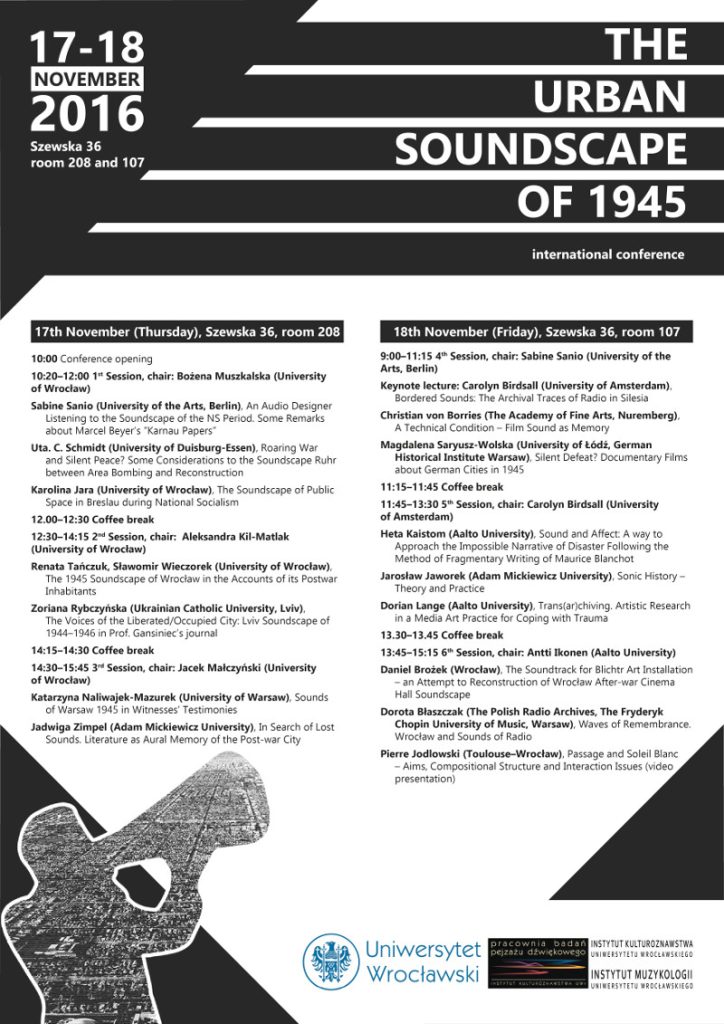
The programme of the conference (pdf)
The idea behind the conference (pdf)
The participants:
- Carolyn Birdsall (keynote speaker)
- Christian von Borries
- Sabine Sanio
- Dorian Lange
- Heta Kaisto
- Uta C. Schmidt
- Zoriana Rybczyńska
- Pierre Jodlowski
- Dorota Błaszczak
- Daniel Brożek (the Blichtr recording)
- Jarosław Jaworek
- Jadwiga Zimpel
- Karolina Jara
- Katarzyna Naliwajek-Mazurek
- Magdalena Saryusz-Wolska
Conference Organisers: dr hab. Renata Tańczuk (Institute of Cultural Studies, Soundscape Research Studio, University of Wrocław), dr Sławomir Wieczorek (Institute of Musicology, Soundscape Research Studio, University of Wrocław)
Venue: Soundscape Research Studio Wrocław / Institute of Cultural Studies / Institute of Musicology, University of Wrocław, Wrocław, ul. Szewska 36
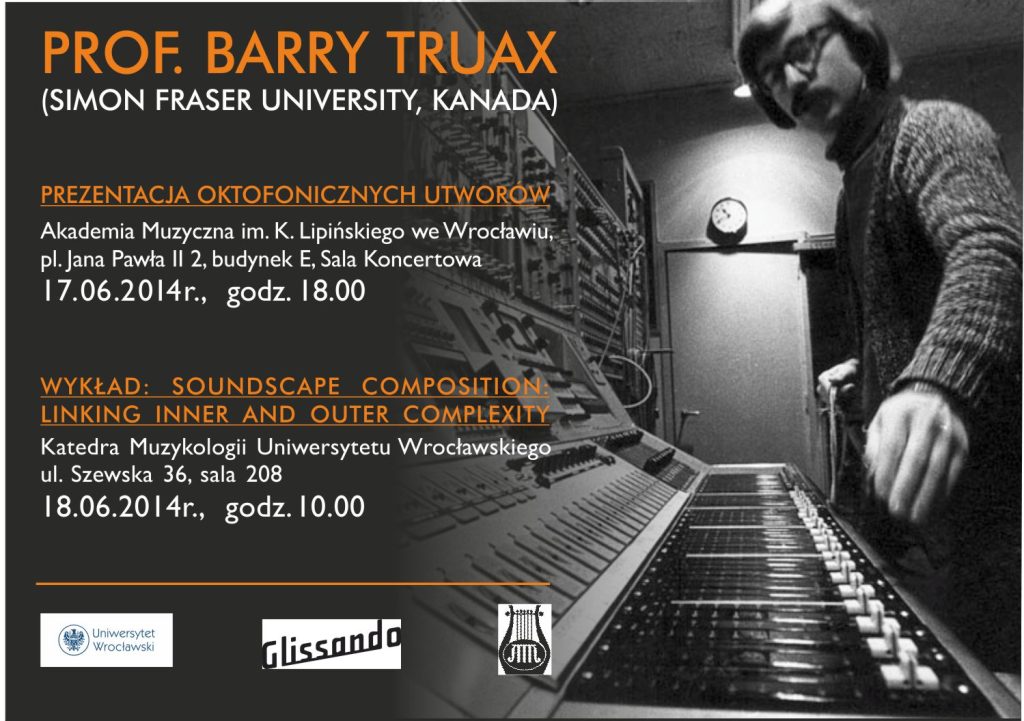
BARRY TRUAX, SOUNDSCAPE COMPOSITION LINKING INNER AND OUTER COMPLEXITY (2014)
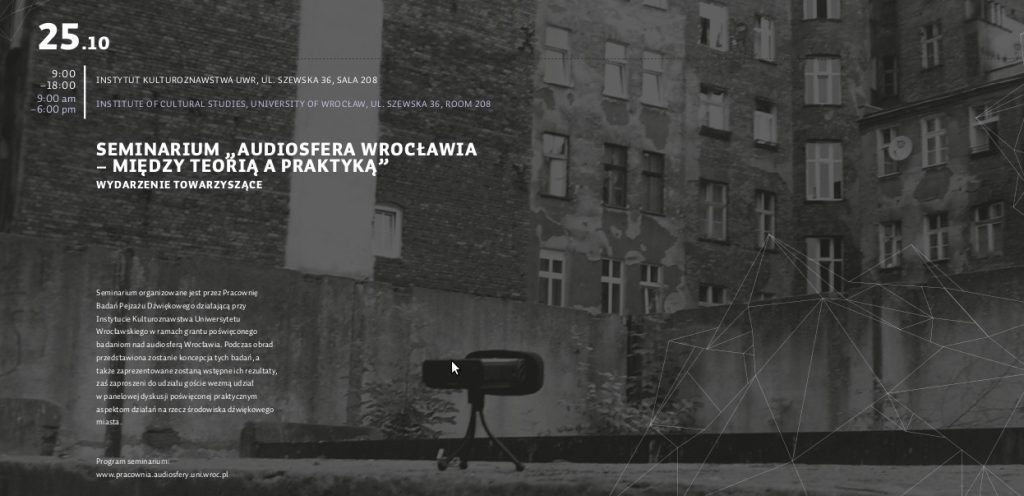
SEMINARIUM AUDIOSFERA WROCŁAWIA – MIĘDZY TEORIĄ A PRAKTYKĄ (2013)
Seminarium naukowe połączone z debatą poświęconą współczesności i przyszłości wrocławskiej audiosfery
Instytut Kulturoznawstwa Uniwersytetu Wrocławskiego, Wrocław, 25.10.2013 r.
Program seminarium:
9.00 Prof. Stefan Bednarek – uroczyste rozpoczęcie
9.15-11.15 PANEL BADACZY I PRAKTYKÓW cz. 1.
- Renata Tańczuk – Wokół badań nad recepcją audiosfery Wrocławia
- Barbara Rudno-Rudzińska – Mapa akustyczna a klimat akustyczny miasta
- Tomasz Sielicki – Dźwięki minione. Wokół badań historycznych nad dźwiękami Wrocławia
- Krzysztof B. Marciniak – Spektrogram jako narzędzie w badaniach nad pejzażem dźwiękowym miasta
Dyskusja. Prowadzenie: Robert Losiak
11.15-11.30 Przerwa
11.30-13.30 PANEL BADACZY I PRAKTYKÓW cz. 2
- Anna Rumińska – Event czy placemaking? Rola i szanse dźwiękowej aktywności w przestrzeni publicznej miasta
- Wacław Szarejko – Dźwięk w strukturze urbanistycznej miasta
- Tadeusz Mincer – Problem audiosfery Wrocławia w kontekście organizacji Europejskiej Stolicy Kultury 2016
- Maciej Bączyk – Strzępy audiosfery. Kilka luźnych uwag o tym, co można przypadkiem usłyszeć w tłoku chodników
Dyskusja. Prowadzenie: Robert Losiak
13.30-14.00 Przerwa
14.00 – 15.45 PANEL ARTYSTÓW cz. 1.
Elżbieta Sikora Pierre Jodlowski Mateusz Ryczek
16.00 – 18.00 PANEL ARTYSTÓW cz. 2.
Krzysztof Knittel [wypowiedź nagrywana] Gerard Lebik Kamila Staśko-Mazur Daniel Brożek
OGOLNOPOLSKIE SEMINARIUM AUDIOSFERA MIASTA (2010)
Instytut Kulturoznawstwa Uniwersytetu Wrocławskiego, Wrocław 28.05.2010
Organizacja: dr Robert Losiak, dr Renata Tańczuk
Program:
1. Prof. Krystyna Pawłowska (Instytut Architektury Krajobrazu, Politechnika Krakowska) Dźwięk jako środek wyrazu w sztuce ogrodowej i architekturze krajobrazu miejskiego
2. Dr Sebastian Bernat (Instytut Nauk o Ziemi, UMCS Lublin) Zarządzanie krajobrazem dźwiękowym miast
3. Prof. Maria Zduniak (Katedra Muzykologii, Uniwersytet Wrocławski) Muzyka w ogrodach dziewiętnastowiecznego Wrocławia
4.Prof. Dariusz Czaja (Instytut Etnologii i Antropologii Kulturowej, Uniwersytet Jagielloński) Szmery, szepty, krzyki. Muzyka wenecka
5. Arch. Anna Rumińska (architekta, antropolożka kultury, Inicjatywa Edukacyjna eMSA, Wrocław) Audiosfera, architektura, antropologia. Spójność czy sprzeczność?
6. Dr Andrzej Dębski (Centrum im. W. Brandta, Uniwersytet Wrocławski) Audiosfera wczesnych kina na przykładzie Wrocławia
7. Prezentacja materiałów instalacji fonicznej „Spacer dźwiękowy” Macieja Bączyka i Pawła Romańczuka, zaprezentowanej podczas 27. Festiwalu Polskiej Muzyki Współczesnej Musica Polonica Nova we Wrocławiu, 07.05.- 16.05.2010 r.
8. Dr Ewa Kofin (Instytut Kulturoznawstwa, Uniwersytet Wrocławski) Muzyka jako hałas
9. Dr Agnieszka Janiak (Instytut Dziennikarstwa i Komunikacji Społecznej, Dolnośląska Szkoła Wyższa, Wrocław) Determinaty audiosfery współczesnego domu wielkomiejskiego
10. Mgr Sławomir Wieczorek (Katedra Muzykologii, Uniwersytet Wrocławski) Polityczny wymiar audiosfery miasta
11. Mgr Rafał Kołacki (Instytut Socjologii, UMK Toruń) Kilka uwag na temat audiosfery miasta Torunia na przykładzie prezentacji multimedialnego projektu Tonopolis
12. Dr inż. Maurycy Kin, mgr inż. Urszula Rysiewicz (Instytut Telekomunikacji, Teleinformatyki i Akustyki, Politechnika Wrocławska), mgr Michał Siciński (Akademia Muzyczna, Wrocław) Wybrane atrybuty obrazu słuchowego w salach koncertowych Wrocławia